HMP FairShare Payout System
Every miner earns their fair share. Small miners get a boost. Loyal miners get rewarded. The block finder gets extra. Transparent, automatic, and built for the community.
💡 How It Works
When the pool finds a Bitcoin block, the 3.125 BTC block reward is split using our HMP FairShare formula:
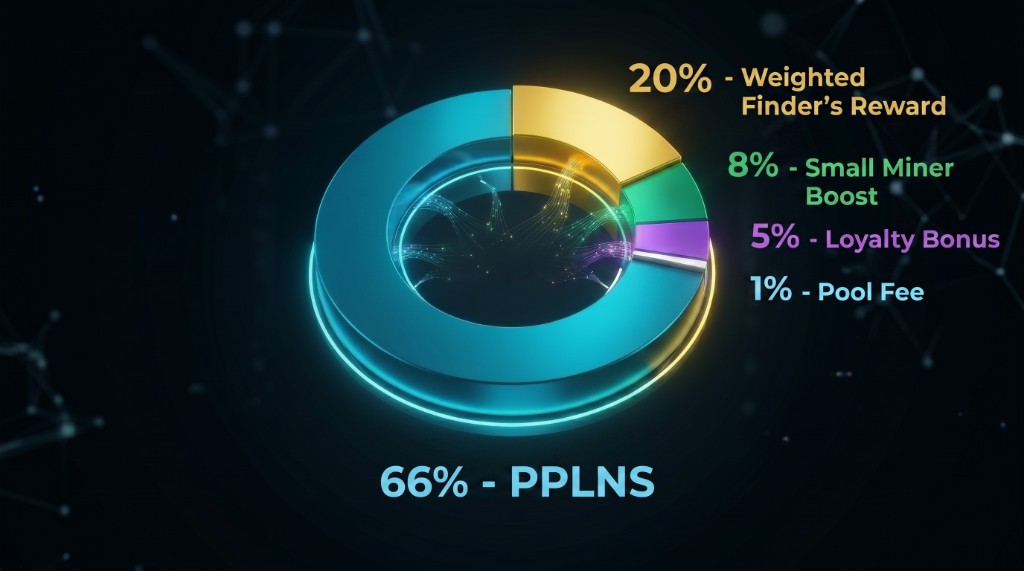
Goes to the miner who found the block. Scales with active hours, up to 29% at the 168h tier.
Split equally among miners active 4+ days with no gap over 24 hours in the payout window.
Distributed proportionally to all miners based on shares submitted in the last 7 days.
HMP FairShare: Every block reward is split with no pool fee, 0% pool fee, up to 29% weighted finder (0.90625 BTC), 5% loyalty (0.15625 BTC, equal split), and 66% PPLNS (2.0625 BTC, proportional by 7-day shares).
The finder also earns their normal PPLNS share, the finder bonus is extra, on top of their proportional share.
Earnings Calculator
Enter your hashrate to estimate PPLNS earnings. We also show the finder bonus you would get if your share solves a block. All pools on HashedMax use HMP FairShare with a finder bonus.
Loading live pool stats…
🤔 Why HMP FairShare?
Most pools are either solo (winner-takes-all) or plain PPLNS (proportional only). HMP FairShare goes further, rewarding loyalty and giving the block finder a meaningful bonus:
- Consistent earnings , Every miner earns proportionally for every block found, even tiny hashrate miners. No more "nothing until you win" solo volatility.
- Finder's bonus incentive , The miner whose share actually solves the block gets a meaningful up to 29% bonus. This rewards contribution and keeps mining exciting.
- Fair for all sizes , Whether you have 1 kH/s or 100 TH/s, you earn your proportional share. Bigger hashrate = more shares = larger payout, but every hash counts.
- Reduced variance , Unlike solo mining where only one person wins, our hybrid system means everyone earns every time a block is found.
⏳ Payout Timeline
1. Block Found
A miner in the pool submits a share that solves a Bitcoin block. The full 3.125 BTC reward is received by the pool wallet.
2. Round Calculated (Instant)
Within seconds, the system calculates each miner's share of the reward based on their contribution over the past 7 days. Credits are added to miner balances.
3. Coinbase Maturity (100 blocks / ~16 hours)
Bitcoin requires 100 confirmations before coinbase rewards can be spent. The pool waits for full maturity to ensure the block is confirmed.
4. Payout Sent
Once matured, miners with balances above the 10,000 sat minimum threshold receive their BTC in a batched on-chain transaction. Balances below the threshold continue to accumulate.
5. Force Payout (90 days)
Any remaining balance above dust (546 sats) is automatically paid out after 90 days, even if it hasn't reached the minimum threshold. No miner's earnings are ever lost.
📈 Real Example: 1,000 Miners
Here's what happens when the pool finds a block with 1,000 active miners. Payouts are based on the total share difficulty each miner submits during the 7-day PPLNS window, not hashrate alone. Higher hashrate generally produces more shares, but the actual accepted share difficulty is what determines your cut. Approx. Hashrate shows each group's combined hashrate. Block reward: 3.125 BTC.
| Miner Type | Count | Approx. Hashrate | % of Total Shares | Share Pool Earned | Per Miner |
|---|---|---|---|---|---|
| Block Finder FINDER | 1 | 6 GH/s | 0.00045% | 0.0000094 BTC | 0.90678 BTC |
| Large ASICs (S19/S21) | 10 | 1,000 TH/s | 75.64% | 1.5606 BTC | 0.15606 BTC |
| Mid ASICs (S9/Whatsminer) | 40 | 320 TH/s | 24.21% | 0.4993 BTC | 0.01248 BTC |
| Bitaxe Miners | 199 | 1.19 TH/s | 0.090% | 0.00186 BTC | ~940 sats |
| NerdMiners / ESP32 | 600 | ~800 GH/s | 0.061% | 0.00126 BTC | ~210 sats |
| GPU / CPU Miners | 149 | 500 MH/s | 0.00004% | 0.0000008 BTC | <1 sat |
| Total | 1,000 | 100% | 2.0625 BTC |
How shares determine your payout: The pool assigns each miner a difficulty level based on their hashrate. When your miner submits a valid share, the difficulty of that share is recorded. Over the 7-day window, the total difficulty of all your accepted shares is compared to the total difficulty from all miners in the pool. That ratio determines your percentage of the 66% PPLNS share pool. Hashrate is shown above as a reference, but your actual payout is always calculated from accepted share difficulty.
Finder's Bonus Breakdown: The block finder (a Bitaxe miner at 6 GH/s) earns their normal PPLNS share payout of ~940 sats plus the finder's bonus of 0.90625 BTC (62,500,000 sats). Plus if connected 1+ hour, their loyalty share of ~521 sats (assuming 300 eligible workers). Any miner on any hardware can be the finder.
Small miners and the long game: ESP32 NerdMiners and similar hobby devices earn small amounts from the share pool per block, but those balances accumulate over every block the pool finds. The real opportunity for small miners is the finder's bonus. Every share your device submits is a chance to solve a block and earn the up to 29% finder's bonus (0.90625 BTC in this example). It doesn't matter what hardware found it. A NerdMiner's share that solves a block pays the same finder's bonus as an S21 Pro's share. That's the beauty of the hybrid model.
For perspective: a Bitaxe earning ~940 sats per block from the share pool would reach the 10,000 sat minimum payout after roughly 11 blocks found by the pool.
🔑 Key Details
⏳ How the 7-Day Share Window Works
Your shares do not accumulate value indefinitely. The pool uses a rolling 7-day PPLNS window, which means only shares submitted in the 7 days immediately before a block is found count toward that payout.
A 7-day window rewards loyalty. If you've been mining consistently for a week and lose power for a few hours due to a storm or ISP outage, you keep the vast majority of your share weight. A 12-hour outage only costs you about 7% of your window, not 50%. It also discourages pool hopping and short-term hashrate rental attacks, since a single day of rented hashpower gets diluted by a full week of loyal miners' contributions.
If the pool goes an extended period without finding a block, shares older than 7 days fall out of the window. When a block is finally found, only miners who were actively hashing within the last 7 days receive a cut of the reward.
In short: stay connected, keep hashing, and when a block lands you will receive your proportional share of the reward based on your contributions over the past week.
Have More Questions?
Check our FAQ for detailed answers about payouts, hashrate, and getting started.